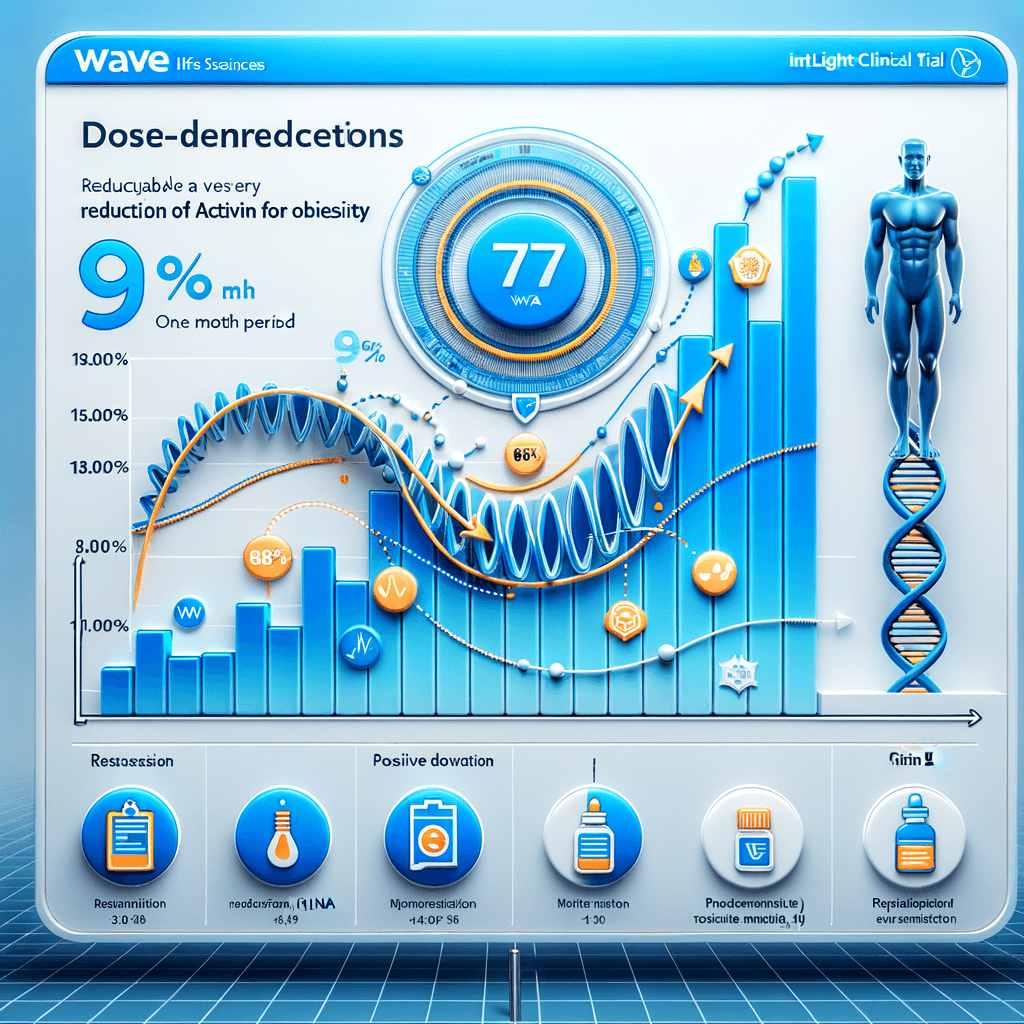
Breakthrough Clinical Results
Wave Life Sciences announced positive Activin E target engagement data from the INLIGHT clinical trial of WVE-007, a GalNAc-siRNA, for obesity. The trial showed dose-dependent reductions of Activin E, with up to 85% reduction one month post-dose. Activin E reduction in the lowest dose cohort was sustained through 6 months, supporting less frequent dosing. The company also announced WVE-008, a PNPLA3 RNA editing candidate for liver disease, with CTA submission anticipated in 2026. Multiple clinical data updates from INLIGHT, including body composition and body weight, are anticipated starting in 4Q 2025.
Key Highlights
- WVE-007 shows dose-dependent Activin E reductions of up to 85% in INLIGHT trial.
- Activin E reduction sustained for 6 months in the lowest dose cohort, supporting less frequent dosing.
- WVE-008, a PNPLA3 RNA editing candidate for liver disease, is on track for CTA submission in 2026.
- Wave is pioneering a new modality by uniting editing and silencing in a single oligonucleotide construct.
Key Unmet Needs and Targeted Populations for Obesity
Unmet Needs in Obesity Medicine
Obesity represents a global health crisis with significant patient burdens and healthcare costs. Despite recent advances, several critical unmet needs persist:
- Better understanding of molecular mechanisms driving disease
- Improved knowledge of natural history and risk factors
- Development of FDA approved therapeutics
- Updated clinical practice guidelines reflecting obesity's pathophysiological basis and heterogeneity
- Standards for quantitative comparison of treatment benefits, risks, and costs
- More effective integration of treatment guidelines into routine clinical practice
- Addressing educational gaps for healthcare professionals regarding the biology and psychology of obesity
- Developing non-invasive assessment methods for obesity-related conditions
- Implementing respectful engagement skills among healthcare personnel
- Creating tailored approaches for patients' unique circumstances
- Establishing long-term group interventions with peer support and multidisciplinary teams
For patients with hypothalamic dysfunction, specific unmet needs include help with diet, exercise, and psychosocial issues, with obesity (50.7%) considered one of their most important health problems.
Targeted Populations
Recent research has identified several populations requiring specialized obesity interventions:
- Gender diverse youth - At risk due to gender-affirming hormone therapy potentially leading to abnormal weight gain and increased BMI
- British Pakistani women in deprived areas with exceptionally high obesity rates
- Cancer survivors - Overweight/obesity identified as a determinant for burden of late effects
- Non-Hispanic Black patients - Experience inferior utilization and outcomes of metabolic and bariatric surgery compared to other groups
- Patients with type 2 diabetes - Targeted with incretin-based dual agonists
- Patients with gout - Report significantly more obesity than controls
- Patients with psoriatic arthritis - 36.8% being obese
- Adolescents with unmet social needs - Particularly those with food insecurity
- Patients with hypothalamic dysfunction - Reporting obesity as a major health concern
- Populations based on age (79% of guidelines), pregnancy (32%), older adults (24%), and people with eating disorders (21%)
Emerging Therapeutic Approaches
Novel treatments showing promise include:
- AT-7687 - A novel GIPR peptide antagonist that maintained weight stability in obese monkeys and showed 16.3% weight reduction when combined with liraglutide
- GalNAc-siPlin2 - A siRNA therapeutic targeting PLIN2 that decreased hepatic triglyceride levels by approximately 60% in obesity-induced mouse models
- Incretin-based dual agonists for patients with obesity and type 2 diabetes
- Medical nutritional therapy as a basic treatment for obesity
- Multidisciplinary care approaches increasingly recognized as important
Despite these advances, significant treatment gaps remain, particularly for youth where lifestyle intervention as monotherapy is often insufficient, and metabolic/bariatric surgery is neither widely accessible nor wanted by most pediatric patients and families.
Study Design Parameters and Endpoints in Key Obesity Trials
Study Designs
Obesity trials predominantly employ randomized controlled trial (RCT) designs with parallel-group configurations. Pragmatic randomized controlled clinical trials assess real-world effectiveness, while multicentre clinical trials enhance generalizability. Trial durations typically span from 3 months to 24 months, with some extending to 5-10 years for long-term outcomes.
Randomization strategies include 1:1 allocation, stratification by factors like center, sex, and BMI, or assignment to multiple intervention arms. Sample sizes vary considerably, ranging from 80-620 participants across different studies.
Blinding approaches include assessor-blinded designs where evaluators and data analyzers remain unaware of group allocation, though some trials are open/non-blinded. Control groups typically involve usual care, waiting list controls, sham procedures, or standard interventions.
Primary Endpoints
The most common primary outcome is weight loss, often measured as percent weight change at specific timepoints (e.g., Week 72 or 76). Other primary endpoints include: * Body fat percentage (BFP) change * Proportion of participants achieving ≥5% body weight reduction * Long-term weight loss (%EBMIL) * Time to weight plateau (TTWP) * Major VTE and VTE-related mortality in thromboprophylaxis studies
Secondary Endpoints
Secondary outcomes encompass a broad range of measurements: * BMI change and waist circumference reduction * Body composition changes measured by dual-energy X-ray absorptiometry * Regional fat distribution (total, subcutaneous, visceral) * Cardiometabolic risk factors including blood pressure, lipid profiles (total cholesterol, LDL, HDL, triglycerides) * Glycemic measures (HbA1c) * Inflammatory markers (hs-CRP) * Hormones like leptin and adiponectin * Quality of life measures * Resolution of obesity-related comorbidities * Treatment adherence and acceptability
Assessment Tools
Trials utilize various assessment methodologies: * Clinical Outcome Assessments (COAs) including patient-reported outcome (PRO) measures and performance outcomes (PerfO) measures * Short Form 36 and Impact of Weight on Quality of Life Lite Clinical Trials are common PROs * 6-minute walk test is the most frequently used performance measure * Digital Health Technologies (DHTs) including smartbands and smartphone applications are emerging in newer studies
Population Characteristics
Participants typically include adults with: * BMI categories: overweight (>25-30 kg/m²), class I (30-35 kg/m²), class II (35-40 kg/m²), and class III (≥40 kg/m²) obesity * Age ranges typically 18-65 years, with some studies focusing on children and adolescents * Obesity-related comorbidities like prediabetes, diabetes, hypertension, or dyslipidemia * Some trials specifically target severe obesity (BMI ≥40 kg/m²)
Cost-effectiveness analyses, such as for Qsymia (phentermine and topiramate extended-release), evaluate interventions using metrics like quality-adjusted life years (QALYs) and incremental cost-effectiveness ratios (ICERs).
Wave Life Sciences Drug Pipeline Indications
I cannot provide information about Wave Life Sciences' drug pipeline indications as there is no data available in the reference materials. The requested information about therapeutic areas, disease targets, investigational drugs, and development status of Wave Life Sciences' pipeline is not present in the source materials.
For accurate and current information about Wave Life Sciences' drug pipeline, I recommend consulting:
- The company's official website
- Recent investor presentations
- SEC filings such as annual reports
- Clinical trial registries like clinicaltrials.gov
- Industry databases that track pharmaceutical pipelines
These sources would provide comprehensive details about the indications, development stages, and therapeutic focus of Wave Life Sciences' current drug candidates.
Contact Us
Address
One Research Ct, Suite 450
Rockville, MD 20850
For General Inquiry
info@pienomial.com