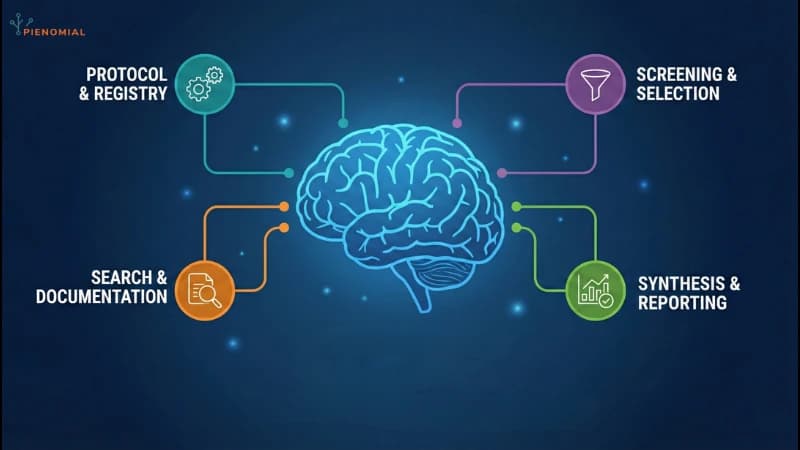
Key Takeaways :
In the complex landscape of Health Economics and Outcomes Research (HEOR) and Market Access, the systematic literature review is the bedrock of evidence. However, generating evidence is only half the process; defending it is the other. As regulatory standards tighten, the difference between a successful submission and a rejected one often comes down to one question: Is your systematic literature review truly audit-ready?
In the complex landscape of Health Economics and Outcomes Research (HEOR) and Market Access, the systematic literature review is the bedrock of evidence. However, generating evidence is only half the process; defending it is the other. As regulatory standards tighten, the difference between a successful submission and a rejected one often comes down to one question: Is your systematic literature review truly audit-ready?
At Pienomial, we understand that a review is only as strong as its traceability. An audit-ready review isn't just about finding the right papers; it's about proving, step-by-step, exactly how you found them.
Why Audit-Readiness Matters in Evidence Generation
The days when a simple bibliography sufficed are long gone. Today, systematic review methodology is under a microscope, and for good reason.
A. Increasing scrutiny from regulators and HTA bodies
Agencies like NICE, HAS, and the FDA are demanding higher standards of rigour. They dig deep into the literature review methodology to ensure that the data presented is comprehensive and unbiased. Any gap in the process can lead to costly questions or delays.
B. Requirement for reproducibility and transparency
Science must be reproducible. If an external auditor cannot replicate your systematic literature review results using your stated protocol, the validity of your entire submission is called into question. Transparency is the currency of trust in evidence synthesis.
C. High stakes in submissions and reimbursement decisions
With millions of dollars in reimbursement potential on the line, the systematic review methodology used must be bulletproof. A flawed review can undermine the economic model it supports, jeopardising market access.
Common Gaps in Traditional Literature Reviews
Despite these high stakes, many teams still rely on manual processes that leave them vulnerable.
A. Inconsistent screening and inclusion criteria
When screening is done in spreadsheets by multiple reviewers without strict controls, inconsistencies arise. One reviewer might include a paper that another excludes, creating a fractured systematic review methodology that fails the consistency test.
B. Poor documentation of decisions
Why was a specific study excluded? "Not relevant" is not an audit-ready answer. Traditional methods often fail to capture the granular reasons for exclusion, leaving a "black box" in the evidence synthesis process.
C. Limited traceability from insight back to source
In a manual workflow, tracing a specific data point back to its source document can be a nightmare. This disconnect makes it difficult to verify claims during an audit, weakening the overall integrity of the systematic literature review.
Core Elements of an Audit-Ready Literature Review
To move from vulnerable to verified, teams must adopt a rigorous audit ready systematic literature review framework.
A. Clearly defined protocols and methodologies
It begins with a protocol that is locked before screening starts. A robust systematic review methodology clearly defines search strings, databases, and eligibility criteria, ensuring that the scope is fixed and unbiased.
B. Transparent screening and data extraction steps
Every decision must be recorded. An audit-ready process captures who screened a paper, when they screened it, and exactly why they made their decision. This creates an unbroken chain of custody for every reference in the literature review.
C. Complete citation and decision trails
Ultimately, you need a "digital breadcrumb trail." From the initial search hit to the final extracted value, every step should be linked. This level of detail in the literature review methodology ensures that any auditor can reconstruct the review path instantly.
How Technology Supports Audit-Ready Reviews
Manual rigour is hard; technological rigour is scalable. This is where tools like Knolens SLR transform the process.
A. Automating documentation and traceability
Technology automates the "boring" but critical work of tracking. Knolens SLR automatically logs every user action, creating a timestamped audit trail that manual spreadsheets simply cannot match. This ensures your systematic review methodology is documented in real-time.
B. Reducing human error and bias
By enforcing workflow constraints such as blinding reviewers during screening, technology minimises bias. It ensures that the literature review methodology is applied consistently across the team, reducing the risk of human error.
C. Enabling faster review without compromising rigour
Speed and quality are often seen as trade-offs, but technology breaks this compromise. AI-assisted sorting and extraction allow teams to conduct a high-quality literature review in a fraction of the time, without cutting corners on the audit trail.
Benefits for HTA and Regulatory Teams
Adopting an audit-ready approach pays dividends beyond compliance.
A. Faster review cycles with greater confidence
When the methodology is transparent and organised, internal QC becomes faster. Teams can sign off on submissions with confidence, knowing the underlying evidence is solid.
B. Reduced risk during audits and submissions
An audit-ready systematic literature review is an insurance policy. When regulators ask questions, you have the answers at your fingertips. This drastically reduces the operational risk associated with evidence synthesis.
C. Stronger credibility with external stakeholders
Ultimately, a transparent, reproducible methodology builds reputation. It signals to payers and regulators that your data is robust, trustworthy, and ready for scrutiny.
Conclusion
In the era of data-driven healthcare, audit-readiness is not an optional "nice-to-have"; it is a critical requirement for market access. By rigorous application of systematic review, pharma teams can ensure their evidence stands up to the toughest challenges.
It is time to stop fearing the audit and start designing for it. Ready to prove your evidence? Explore how Pienomial supports transparent, audit-ready evidence generation, ensuring your next submission is built on a foundation of unshakeable trust.